(Text: author, photos: Joachim Horschig, author)
The first volume of my new book on the export versions of the Chinese MiG-21 alias F-7 has recently been published. Actually a subject that should interest only very few specialists. And yet this closed chapter of technological history tells us quite a lot about one of the biggest players in world politics and the economy in general, as the period covered extends from the end of the "Great Leap Forward" in 1961 to the full development of Deng Xiaoping's economic reforms in the mid-2000s.
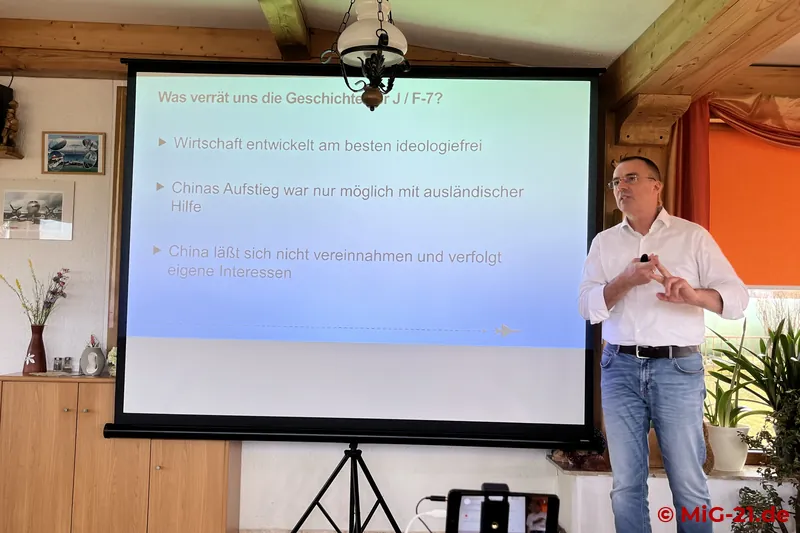
First of all: an economy develops best when it is run free of ideology. Only after Mao had died and the economy had been freed from ideological shackles did China's economic and technological development, which had almost come to a standstill in the years of the Cultural Revolution, pick up speed.
It also quickly becomes clear that China's rise from a backward agricultural country to a leading economic power was only possible with foreign help – first from the East, because the People's Republic of China was seen there as an ally in world revolution, and then from the West, to build China up as a counterweight to the Soviet Union. Soviet technology transfer made it possible for China to produce modern aircraft in the first place. Western deliveries of avionics and guided weapons then allowed China to catch up with the state of the art. From the point of view of the respective counterpart, both approaches ultimately failed because China does not allow itself to be co-opted, pursues its own interests and knows how to play political rivals off against each other.
In view of the recently re-ignited Indian-Pakistani conflict, a look at the symbiotic relationship between China and Pakistan, especially in the military field, is also interesting. Pakistan is not only the biggest customer for the F-7 and for Chinese military technology in general, but during the F-7's development also gave China extensive insight into the technology it had procured from the West. In addition, the country drove Chinese development forward with high requirements. As a result, Pakistan received F-7 versions that were superior to the variants for domestic use. Even though China today reserves the best technology for its own needs, it cannot be ruled out that Pakistan, as a special ally, also receives it and thus achieved its recent successes in the confrontation with its arch-enemy India.
And of course: China knows how to copy – whether documentation is available (as with the original licence production of the MiG-21) or not (as with the attempt to copy later versions). China copies so successfully that the copy largely matches the original, and is then able to develop the copy further into its own solutions.
Finally, it is striking that China relatively quickly managed to acquire or develop a wide range of technologies itself – with one exception: engines. Here foreign technology was adopted and adapted, but hardly any of its own was developed, or only very slowly. The reason: mechanical engineering, and especially the development of heat engines, is experience-intensive and not something that can be conjured up quickly. Let that be a lesson to all those who want to sacrifice Europe's remaining technological leadership in combustion engines to the electric ideology.
So sometimes a look at a small aircraft is enough to gain insights into big politics.
Fliegerstammtisch Cämmerswalde, March 2026
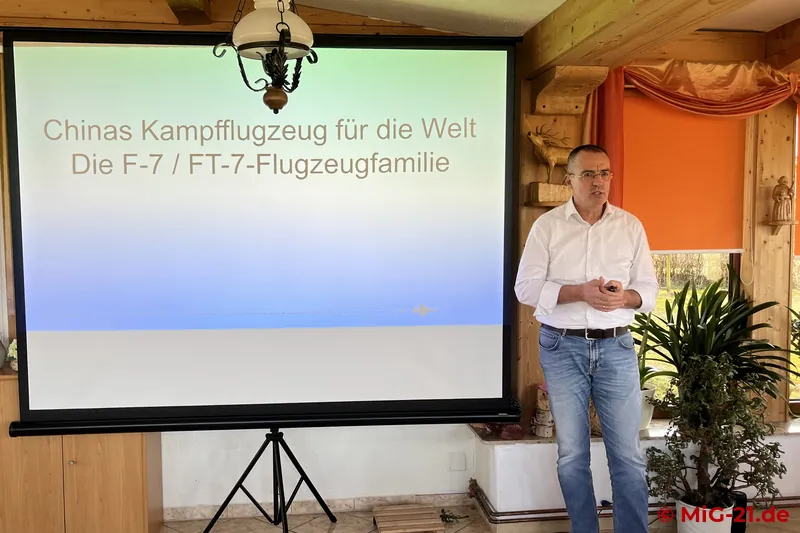
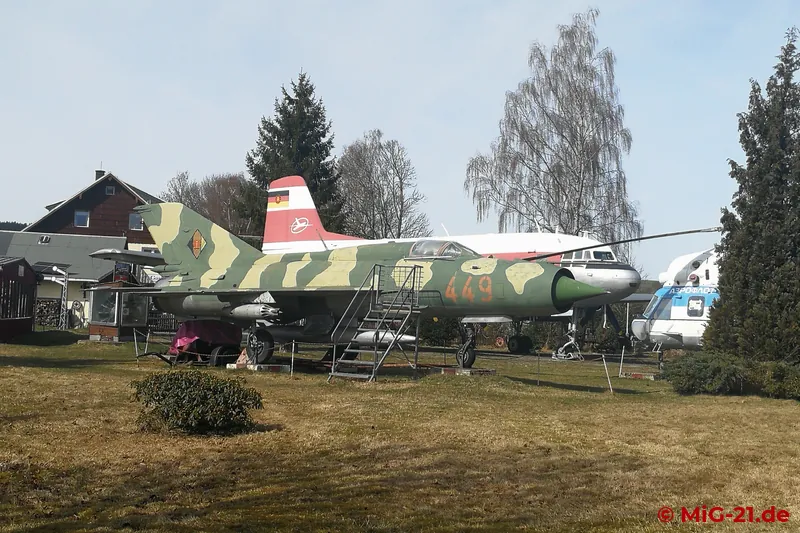
To convey the findings of the book research to a wider circle of interested people, the idea arose for a new lecture entitled "China's fighter for the world – the F-7 / FT-7 aircraft family". After the pleasing response to my lecture Halfway around the world for the MiG-21 at the Fliegerstammtisch Cämmerswalde, the premiere was to take place on March 28, 2026 at the venue there, the Gaststätte am Flugzeug.
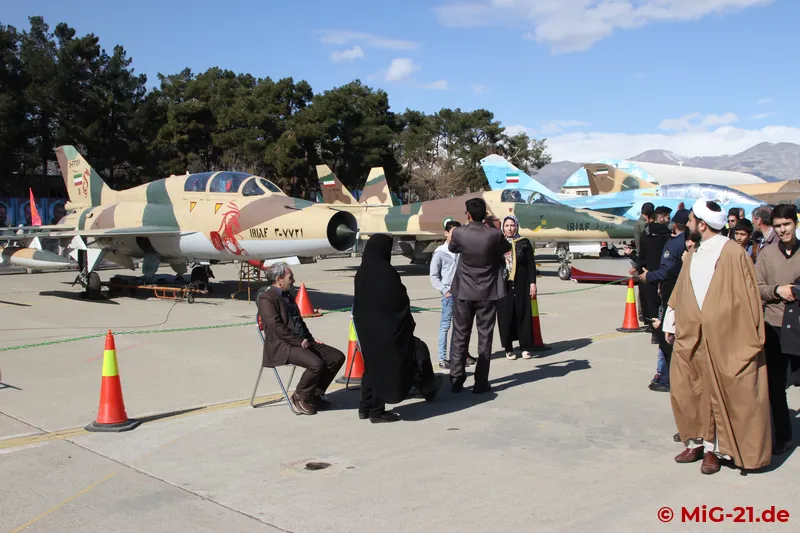
Actually, F-7 pictures from the airshow marking the 75th anniversary of the Sri Lanka Air Force were to provide the transition from the previous lecture to the current one, but the outbreak of war in the Middle East had thwarted my trip there. Instead, a picture from my visit to Tehran in 2019, combined with satellite images of destroyed Iranian FT-7s, formed the sad prelude. The lecture itself, however, dealt not with current affairs but with technical-historical matters. A good 20 interested people had come and this time only had to be patient for about two hours until my lecture ended with a summary of the thoughts mentioned above.